SAM KERR ON SUCCESS, SACRIFICE & WHAT COMES NEXT - Kanebridge News
Share Button

SAM KERR ON SUCCESS, SACRIFICE & WHAT COMES NEXT

The Matildas captain has joined one of the world’s most exclusive luxury watch brands, sharing candid insights into the sacrifices required to succeed at the highest level of world football.

By Jeni O'Dowd
Wed, Jun 10, 2026 2:38pmGrey Clock 3 min

Australian football superstar and Matildas captain Sam Kerr has joined one of the world’s most exclusive luxury watch brands, reflecting on the sacrifices behind a career at the pinnacle of professional sport and revealing she only signed with her new club last week.

As Richard Mille’s first and only Australian partner, Kerr has joined an elite group of global athletes, artists and innovators associated with one of the world’s most prestigious watchmakers.

Speaking in Sydney, the 32-year-old reflected on her next chapter, the extraordinary growth of women’s football and the personal sacrifices required to reach the top of the game.

Founded in 2001, Richard Mille has built a reputation for producing some of the world’s most technically advanced and exclusive timepieces. The Swiss watchmaker is renowned for its use of ultra-lightweight materials, Formula One-inspired engineering and limited-production watches that often sell for hundreds of thousands of dollars and, in some cases, more than $1 million.

Its ambassadors include tennis great Rafael Nadal, Formula One stars Charles Leclerc and Lando Norris, actress Michelle Yeoh and sprint champion Shelly-Ann Fraser-Pryce.

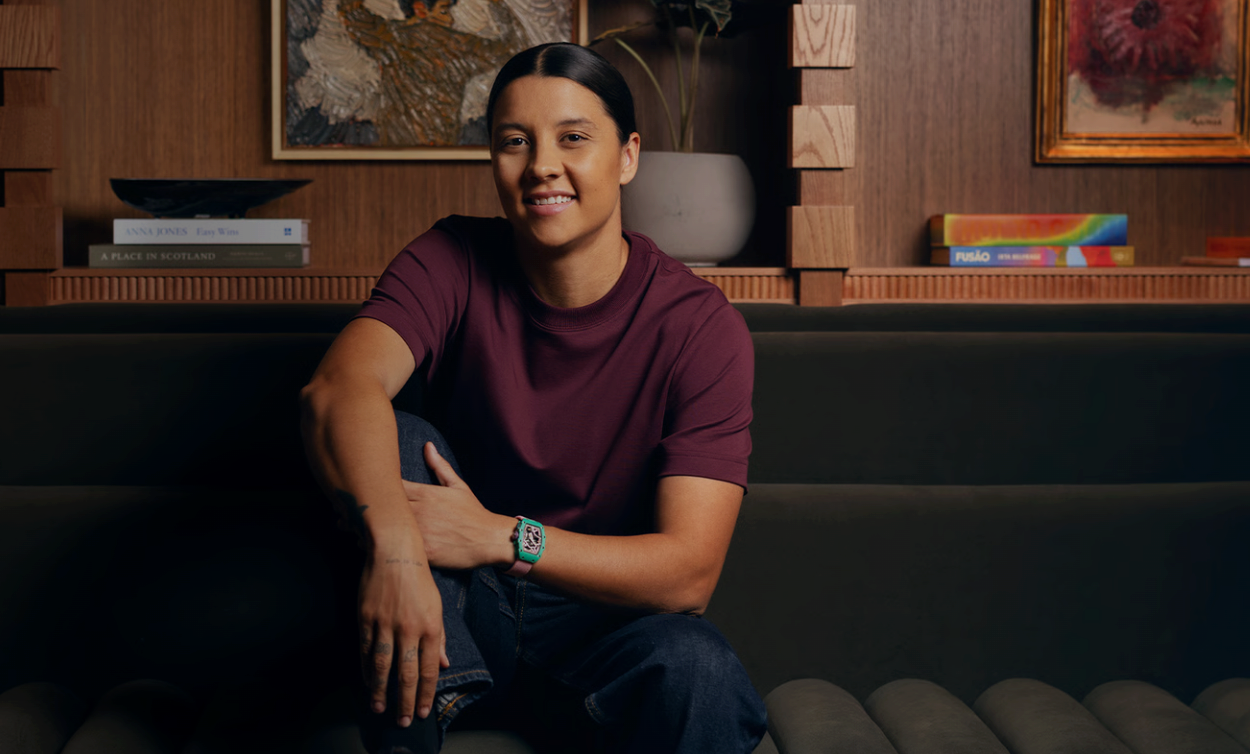
During the Sydney event, Kerr wore the Richard Mille RM 07-04 Automatic Sport, a lightweight model featuring a pink case, blue strap and skeletonised movement. Designed for active lifestyles, the watch reflects the brand’s philosophy of combining high-performance engineering with luxury craftsmanship.

For Kerr, becoming the brand’s first Australian partner is a source of considerable pride.

“Of course, being the only Australian is incredible to me,” she said. “I am very proud to be Australian and I like to put Australia on the map.”

The announcement comes as Kerr prepares for the next stage of her football career following her departure from Chelsea after six-and-a-half years.

While speculation around her future has been mounting for months, Kerr revealed a decision was only finalised recently.

“Everyone thinks that it was decided and I’ve known that (it was) reported that I’d signed somewhere in April, but honestly, I only signed my contract on Wednesday last week,” she said.

“I really hadn’t decided what I was going to do until last week.”

Kerr said she expects details of her new club to be announced around the beginning of July once her Chelsea contract officially concludes.

Despite her excitement about what lies ahead, she admitted leaving one of the world’s biggest football clubs has been emotional.

“I am really sad about it,” she said. “It’s been my home for 6.5 years. I have so many good memories there. I have so many amazing teammates. I’m sad to leave.

“It sucks to leave such a big club like Chelsea too, but it comes to an end to everything, right?”

The 32-year-old also reflected on the transformation of women’s football during her career, describing the Matildas’ rise from relative obscurity to household-name status as one of her proudest achievements.

“What the Matildas have done over the last four or five years has been incredible,” she said.

“The most important thing for me is that you leave the game in a better place.”

Kerr noted that when she began playing, there were few professional pathways for women, limited sponsorship opportunities and crowds that bore little resemblance to those regularly attending matches today.

“We are a part of that generation that still knows what it was like when there was no one in the crowd,” she said.

Today, she said, crowds of tens of thousands remain something the team never takes for granted.

“Even last night we had 20,000 on a Tuesday night nearly. That’s special to us,” she said.

“We feel very lucky that people come out and spend their money and come to a game and watch us.”

Yet behind the accolades, sponsorships and sold-out stadiums, Kerr said there have been significant personal sacrifices.

“I’ve been living out of home since I was 17 years old. I’ve missed a lot of my family’s life,” she said.

“I’ve missed a lot of weddings. I’ve missed funerals. I’ve missed so many things that people don’t see.”

Kerr revealed she was unable to return home for her grandmother’s funeral last year because of football commitments.

“You have to love what you’re doing. You have to want to sacrifice,” she said.

“Everyone makes sacrifices, of course, and what I do is a massive privilege, but there comes a lot of sacrifice with it.”

Away from football, Kerr said Australia remains central to her identity despite spending much of her adult life overseas.

“I think we take for granted in Australia the beaches, the ocean, the open spaces,” she said.

As she prepares for a new club, a new season and a new role with Richard Mille, Kerr said she remains motivated by the same passion that first drew her to the game as a teenager.

“It was really organic,” she said of her relationship with the luxury watchmaker.

“It’s a real family brand.”

MOST POPULAR

Following the successful launch of its Palais Collection, MAISON de SABRÉ has unveiled a new modular handbag system offering more than 720 styling combinations.

Automobili Lamborghini and Babolat have expanded their collaboration with five new colourways for the ultra-exclusive BL.001 racket, limited to just 50 pieces worldwide.

Related Stories
Lifestyle
Is the Weight-Loss Drug Revolution Causing a Frailty Epidemic?
By Natasha Dangoor 18/05/2026
Lifestyle
MAISON de SABRÉ unveils its most personalisable handbag collection yet
By Jeni O'Dowd 18/05/2026
Lifestyle
ITALY’S FINE WINES GAIN GROUND AS VALUE PLAY FOR COLLECTORS
By Jeni O'Dowd 05/05/2026

As millions flock to GLP-1s, doctors warn the drugs can cause rapid and significant muscle loss.

By Natasha Dangoor
Mon, May 18, 2026 5 min

Chanel Robinson achieved exactly what the gold rush of blockbuster weight-loss drugs promised: She lost nearly 100 pounds, lowered her cholesterol to normal levels and reined in her polycystic ovary syndrome.

Yet, nearly three years into her journey on Mounjaro, the 30-year-old from Atlanta, Ga., is discovering the hidden costs of the slimmed-down life.

Robinson experiences muscle fatigue daily, feeling physically weak, frail and often cold. Robinson said she experiences bursts of sluggishness sporadically during the day, and has trouble with basic tasks like opening a jar. “It shouldn’t be this difficult,” she said.

GLP-1 drugs like Ozempic, Mounjaro and Zepbound have been a success for public health and the pharmaceutical companies that make them. Obesity rates are falling, the volume of food consumed in America is declining and retailers report a slump in sales of plus-size apparel. It has improved health and happiness for millions of people.

But for at least some of the 13 million Americans taking them, losing muscle along with fat is an unexpected downside that isn’t broadly discussed or immediately apparent.

The drugs can cause rapid and significant loss of lean muscle mass, up to 10%, comparable to a decade or more of aging, according to an analysis published by the American Diabetes Association.

The loss of lean tissue is similar to weight loss from dieting, but the magnitude over a short period can lead to frailty, instability and lack of coordination, doctors and researchers say. Another concern is that losing muscle could slow down patients’ metabolism, leading to weight regain.

“We are curing obesity by encouraging frailty,” said Daniel Green, principal research fellow at the University of Western Australia, who contributed to the analysis. Many taking weight-loss medications initially lose fat and feel great, but quickly start to feel weak and lethargic, he said.

Green’s research showed that the rate of muscle loss could be slowed significantly by regular strength workouts. “It should say ‘must be taken with resistance training’ on the box,” he said.

Drugmakers say weight-loss drugs should be taken only on the advice of a physician and as part of a long-term plan that includes diet and exercise.

A spokesperson for Eli Lilly, maker of Zepbound, said Food and Drug Administration guidelines say it should be used “with increased physical activity.” The spokesperson added: “Sustainable weight loss is about more than a number on a scale.”

Both Eli Lilly and Novo Nordisk said clinical trials showed users did lose some lean muscle tissue, though at far lower rates than fat. Liz Skrbkova, a spokeswoman for Novo Nordisk, said that trials for its drug Wegovy showed changes in muscle mass didn’t “significantly differ” from patients who took a placebo. Eli Lilly said users lost three times more fat weight than lean tissue.

Rayna Kingston, 30, from Denver, said her injections of Zepbound left her feeling so tired the following day that she struggled to complete anything other than basic tasks. She said she shifted her dose to a Sunday because Mondays were her least busy day. Her partner would bring her meals in bed because she felt so weak.

She stopped exercising, and said her doctor didn’t give her any guidance on strength training or muscle maintenance. “I was relying on Reddit forums to understand what was happening to my body,” she said. She got so frustrated with the fatigue she came off the medication just under two months later.

Experts say that losing muscle at such a rate can be especially dangerous for those over 50 or with osteoporosis or limited mobility as it could lead to an increased risk of injury. “Loss of muscle mass is detrimental to moving around and quality of life, but it is also not safe,” said Katsu Funai, associate professor at the University of Utah.

Elderly Americans are set to be able to get GLP-1s from Medicare from July.

There is also pushback from doctors and regulators against using weight-loss drugs as a “quick fix” to lose a bit of weight.

People who take GLP-1s regain weight four times faster than those who lose weight through lifestyle interventions, and weight regained is often mostly fat, according to a recent analysis published in the British Medical Journal. There currently are few, if any, guidelines or studies on de-prescribing the drugs, researchers say.

The nurse practitioner who prescribed Robinson the medication didn’t warn her that resistance training is essential to maintaining muscle mass, Robinson said. She said she regrets not exercising and now does Pilates once a week.

In the haste to disrupt the obesity epidemic, weight loss has been treated as the singular, undisputed metric of success, which experts say is problematic.

“People worship body weight as an outcome measure because it’s simple, quick and inexpensive,” said Green. “But what matters is fat and muscle mass, which is more expensive to measure as it requires an MRI.”

Grace Parkin, 34, a property manager from Sheffield, England, has lost 125 pounds after she started taking Mounjaro in 2024. “I don’t care about my muscle mass as long as I’m a healthy weight,” she said.

The doctor who prescribed the drug didn’t tell her to exercise, though the pharmacy that sold the medication gave her information on exercise and protein intake, she said.

She didn’t exercise and said she soon felt side effects: a “deathly cold, from the inside” likely because of the drug. Still, she vowed to keep going, saying the weight loss was worth it.

In response to some of the side effects, drug companies are hoping to develop weight-loss treatments aimed at preserving or even building lean muscle mass.

German drugmaker Boehringer Ingelheim recently said it had promising results from one such drug. Eli Lilly last September halted a trial of a similar drug.

While weight-loss medications are designed as lifelong treatments for chronic diseases, namely obesity and Type 2 diabetes, they are increasingly marketed as lifestyle fixes.

Tennis superstar Serena Williams, who used GLP-1s to slim down after having children, was featured in this year’s Super Bowl commercial promoting telehealth company Ro’s weight-loss medication.

Serena Williams holding a GLP-1 weight-loss medicine injector.

Serena Williams poses for an ad campaign for a weight-loss drug. Ro/Handout/Reuters

Women may be particularly vulnerable to the drugs’s side effects, which can also include nausea, diarrhea, migraines and rarer cases of pancreatitis.

A study last year from a university hospital in Turin, Italy, showed that women are more prone to adverse reactions to weight-loss drugs than men, including muscle loss.

Green, the researcher, said the issue is of particular concern to those taking GLP-1s recreationally and who don’t have much muscle mass to begin with. Others say a lack of oversight is compounding the issue.

“Patients are self-reporting, and telehealth companies don’t have the patient in front of them to conduct a proper medical assessment,” said Rupal Mathur, an internist in Houston whose practice specializes in weight loss.

She said medical spas are prescribing off-label drugs that don’t meet the criteria set out by the FDA that justify a prescription.

The number of people taking weight-loss drugs who are not living with obesity or Type 2 diabetes is difficult to track since it is unregulated.

However, an analysis by the FDA from 2023 found that more than half of new Ozempic and Mounjaro users didn’t have Type 2 diabetes.

Scientists are calling for more clinical trials to pin down the full effects of weight-loss drugs on muscle loss in different demographics.

“The only studies that have been done have looked at people living with obesity or Type 2 diabetes,” said Green. “That makes it all the more concerning for those using weight-loss drugs in an ad hoc or unregistered way.”