The Rise of Million-Dollar Companies With Just One Employee - Kanebridge News
Share Button

The Rise of Million-Dollar Companies With Just One Employee

Artificial intelligence is making it easier than ever to build a business without building a team. As AI takes over coding, customer support, marketing, administration, and other day-to-day tasks, a growing number of solo founders are scaling startups to millions in revenue with few—or even no—employees. While the trend is lowering barriers to entrepreneurship, it is also reshaping hiring, raising questions about the future of work and how businesses will grow in the AI era.

By
Thu, Jul 30, 2026 5:08pmGrey Clock 5 min

Ben Broca launched a company last December that offers AI tools to entrepreneurs. He’s already added 10,000 paying customers and is on track to bring in $10 million in revenue this year.

One thing he hasn’t added: any other employees.

The 40-year-old is part of a class of entrepreneurs who are launching, and then often running, new companies on their own. Artificial intelligence tools answer Broca’s emails, help write and debug code, field requests from customers, sign up new subscribers and grant refunds when issues arise.

Broca relishes his ability to make whatever decisions he wants on his own, often from his sun-drenched Sausalito, Calif., living room. “I think compromises make lukewarm results,” he said.

Once upon a time, running a business of a certain size required a team. AI is turning that assumption upside down, and more aspiring entrepreneurs are going it alone.

Ben Broca sitting in his home office.
Tech has seen an explosion of solo founders in the past year. Broca said he likes being able to work at his own speed, unencumbered by a team. Jonah Reenders for WSJ

An analysis by the payments company Stripe shows there are thousands of solo operators on the company’s platform that are generating over $1 million in revenue, with their ranks doubling between 2023 and 2025. The number of solo operators crossing the $10 million threshold nearly tripled in that same span.

In the past, people without business contacts or particular savvy might not have known how to get their ideas off the ground, said Ernie Tedeschi, Stripe’s chief economist. “Now, AI can be a built-in business partner,” he said.

AI’s ability to handle various administrative tasks makes it potentially useful for launching solo businesses in many fields. But the technology’s ability to also handle key tasks in tech, like coding, make that field a particular hot spot.

Analyzing Census Bureau data, Bank of America Institute economist Taylor Bowley found that among all industries, new business applications in the information sector have seen the biggest percentage increase—nearly 45%—over the past year. At the same time, the rate of information-sector applicants saying they plan to hire workers has experienced the sharpest decline of any measured industry.

This Census dataset doesn’t track solo-operated businesses. But the numbers broadly show—in tech and beyond—that applications are flat among businesses likely to hire workers, but generally rising elsewhere. Economists say that’s a strong sign that solo operators are on the upswing.

“The bar for getting started has never been lower,” said Julian Weisser, who runs a San Francisco-based accelerator for solo founders working in tech. The accelerator—which offers founders seed money and mentorship in exchange for an equity stake—attracted 4,500 applicants for 10 slots made available in its most recent cycle, nearly five times the number it drew when it launched last May.

Going it alone with AI can still be surprisingly expensive. Broca said he was losing money on many customers’ accounts while paying to access Anthropic’s Claude to run his clients’ requests—that AI company, as well as others, charges based on usage. He has since switched to free open-source AI models from China.

Broca said he has raised $30 million from investors and, at the same time, has saved millions in salary since he hasn’t needed a team of software engineers.

Another risk: If it’s easy for one entrepreneur to launch an AI-assisted business, copying them can be easy, too. This creates anxiety for founders like Troy Johnston, who runs an AI-assisted business alone in Orlando, Fla.

“Everybody has the sword and we all have the ability to unsheathe Excalibur now,” said Johnston, 40, who used AI to code an app that helps people get the most out of credit card benefits. The company makes around $3,000 a month in profit, with no employees, and is continuing to grow.

Headshot of Troy Johnston.
Troy Johnston said AI’s power and ease of use is an incredible boon for entrepreneurs like him—and also a double-edged sword. Luann Koerper

What one-person businesses will mean for the labor market remains to be seen. Polling has shown Americans are worried that AI will replace jobs, and top economists are wrestling with that possibility, too. But AI is also creating lots of new jobs, and the go-it-alone entrepreneurs show how the technology can both open doors and limit employment opportunities.

“If everyone’s hiring less, but you get four times more firms, what does that do to head count?” said Rembrand Koning, an associate professor at Harvard Business School who studies entrepreneurship. He co-authored a recent study that found that among 50,000 startups the researchers examined, those focused on AI tended to operate with 25% fewer employees.

Koning also believes a soft hiring environment that’s left some people mired in long job searches has encouraged more to try their hand at launching businesses.

Some founders cite different motives. “It’s a perfect storm of post-pandemic burnout and a re-evaluation of one’s priorities, and also booming AI and a sense of what’s possible,” said Samir Ahmad, 39, who lives in Breinigsville, Pa.

Two years ago, Ahmad decided to leave the corporate job he had worked at Verizon for almost two decades to start a solo coaching and consulting business. He had been seeing social-media posts touting the ease and virtues of AI, which he used to chart a business plan and help with marketing. “It was like my chief of staff, a second in command,” he said.

The business ultimately petered out within months, though, and Ahmad is now back to a full-time corporate role with a utility company.

For Claire Vo, 41, AI helped her turn a passing impulse into a business. She was working full-time as a tech executive when she tapped AI in late 2023 to help code an app that would help her manage documentation and design for new products, with customers ranging from financial services to healthcare firms.

“I was copying and pasting from ChatGPT,” said Vo, who lives in San Francisco.

Claire Vo smiling into the camera while recording a podcast.
Claire Vo used AI to code an app that’s on track to make seven figures in profit this year. Claire Vo

She put the app online for $1 a month, and within weeks people downloaded it thousands of times. Nearly three years later, Vo’s company—which she ran solo for nine months before hiring an engineer—now has 100,000 users and is on track to make seven figures in profit this year. AI handles the company’s marketing, sales and customer support.

While AI is a shortcut, Vo said her network and credibility in the industry were key. “I think people over-index on how easy AI is and under-index on how much I did to get to this point,” she said.

MOST POPULAR

The Australian leather house has opened an immersive four-day pop-up in Manhattan, unveiling its Bloom Collection and redefining what a product launch can look like.

Following the successful launch of its Palais Collection, MAISON de SABRÉ has unveiled a new modular handbag system offering more than 720 styling combinations.

Related Stories
Lifestyle
My First Impressions of the New Folding iPhone Duo
By Nicole Nguyen | Photography by Alexander Hotz for WSJ 10/09/2026
Lifestyle
Academia Is in Trouble and This English Professor Understands Why
By 03/09/2026
Lifestyle
Shein Had 4.4 Billion Reasons to Speed Its IPO Along
By Esther Fung 01/09/2026

Apple’s first foldable, the $1,999 iPhone Duo, combines an iPhone and iPad Mini experience—but its size, weight and price come with compromises.

By Nicole Nguyen | Photography by Alexander Hotz for WSJ
Thu, Sep 10, 2026 4 min

As I watched a Netflix show on Apple’s first foldable, the iPhone Duo, I had two surprising thoughts.

The first: Maybe I don’t need my iPad Mini anymore.

The second: Uh oh, am I about to spend $1,999 on a phone?

I didn’t think folding phones were for me. I’ve been testing Android versions from Samsung and Google since 2019, and those early editions came with too much screen and too many compromises.

Fast forward seven years, and the technology has come a long way. Apple—in its very Apple way—has also come up with some hardware and software trickery to make up for some shortcomings of the basic design. My desire for a folding phone before today was zero. After today, it’s a lot more than zero.

I’m not ready to recommend the Duo, which ships on Oct. 23, just yet. Not until I am able to test it more fully, so be on the lookout for that review in a few weeks. But from what I experienced at Apple Park on Wednesday, I could actually picture myself using this new half-phone, half-tablet hybrid.

Crease camouflage

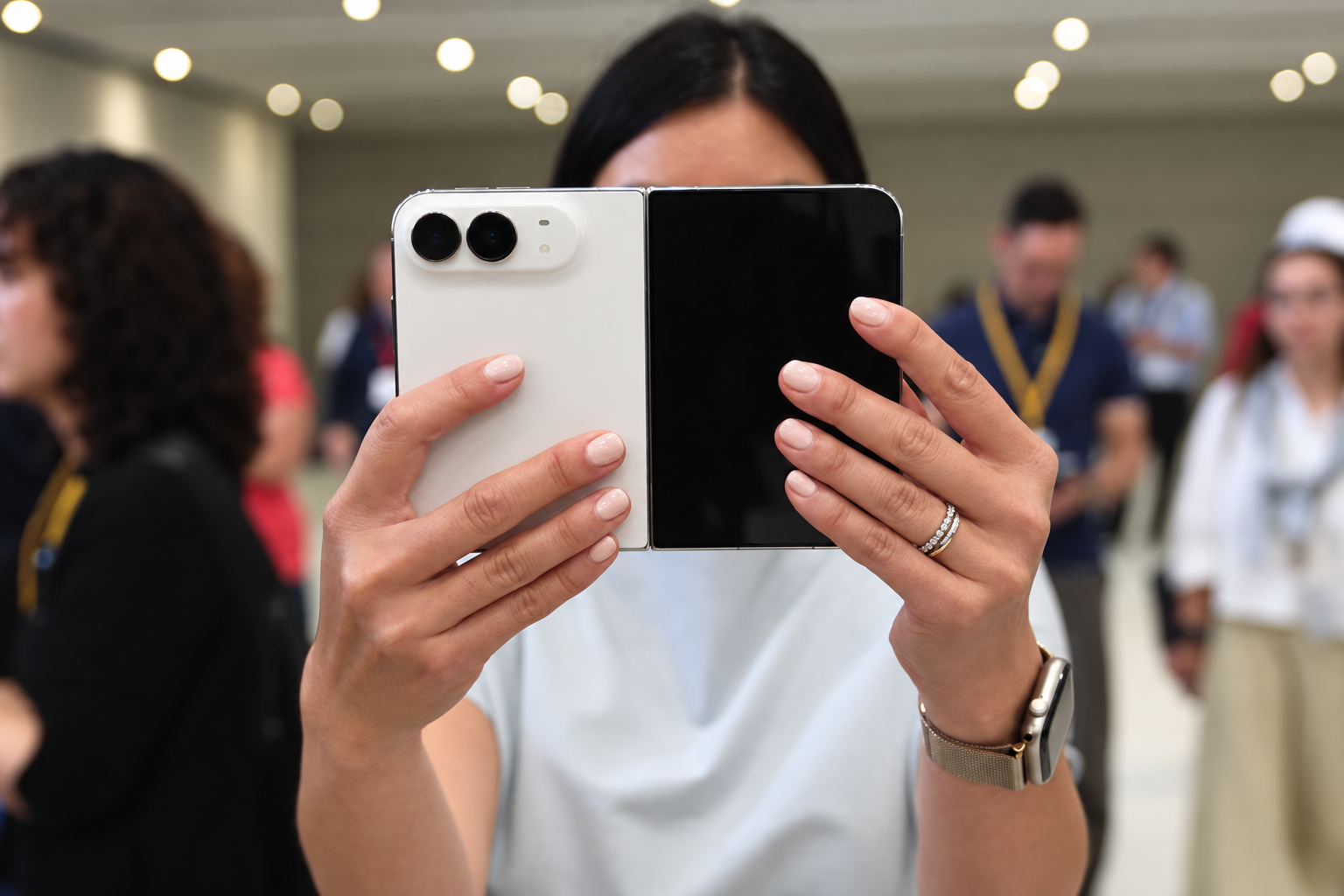
Nicole Nguyen holding the new iPhone Duo.
When opened, the Duo’s exterior screen goes dark.

Nicole Nguyen holding the iPhone Duo with a pink, feathery image on the screen.
The interior screen is almost as spacious as the display on an iPad Mini.

For months, I’ve been using Samsung’s Galaxy Z Fold 8, a similarly squat, passport-shaped foldable that opens up to a larger screen. It’s impressively thin and can easily fit into the infuriatingly tiny pockets in women’s pants and dresses. Samsung did a lot of work to minimize the crease—the dip between the two halves of the big interior display—but it’s still clearly there.

When I held the iPhone Duo open, the crease was barely visible. As I slid my finger across the display, I could feel it, but it’s more subtle than Samsung’s. Most of the time, the screen looked as flat and smooth as the one on an iPad.

Apple employed both software and hardware techniques to camouflage the crease. The matte surface of the interior 7.6-inch screen minimizes reflections to hide it. (Samsung’s Fold 8 screen is shiny.)

And as you begin to open or close the iPhone Duo, the interface shifts the controls and content away from the center crease. If, say, you’re watching a video on the outer screen, you can open the Duo to switch to the bigger display within. A black fade marks the transition. You don’t see the video full screen until the phone is completely flat.

Heavy handed

Apple iPhone Duo foldable smartphone closed.
When closed, iPhone Duo has a chunkier shape than traditional iPhones, with a new interface layout. David Paul Morris/Bloomberg News

My second observation was that, when the Duo is closed, in phone mode, it was harder to use one-handed than I expected.

In the keynote trailer and press release, Apple touted how thin the Duo is. It’s marketed as the thinnest iPhone ever—when open.

But it’s actually thicker and heavier than most of its Android competitors. The Duo weighs 254 grams, and is 11.3 millimeters thick when closed. The Samsung Galaxy Fold 8 is just 201 grams, with a thickness of 9.7 millimeters. Google’s Pixel 11 Pro Fold is 239 grams and 10.1 millimeters.

Because the Duo is also wider than a standard iPhone, I found it quite a challenge to type.

I admit, I do have smaller-than-average hands. So I consulted my colleague Rolfe Winkler, who has a larger grip. He agreed the Duo feels big.

Apple rearranged the interface on the outer screen so it looks different than traditional iPhones. The dock and control center are off to the right to be more reachable. Committing to the Duo as your main device will require adjustments in your handling. You will have to learn a new way to use and type.

Work and play

Nicole Nguyen holding the new iPhone Duo.
When half-folded, the Duo resembles a little laptop, complete with keyboard.

My most surprising takeaway? I feel a pull toward this device.

I always thought that combining an iPhone and an iPad would mean bigger compromises. The battery life is about the same as the 18 Pro (up to 24 hours of “regular use” on a single charge), though I’ll need to verify that in my real-world testing. And it’s also as durable, with the same IP68 dust- and water-resistance rating as the rest of the iPhone lineup.

There are trade-offs, for sure. Trying out the camera, I immediately missed the 8X zoom in my Pro model. The Duo has just 2X zoom, which wouldn’t cut it for the dozens of pictures I take of my kid every day.

But the dual screens unlock new photo functionality. You can see what your shot looks like from the outside screen. As someone who has tried tirelessly to self-direct a family photo—or a spouse—I am very eager to try this out more.

Foldables, I initially thought, were for classic mobile-warrior jet-setter types, who never sit at a desk and are always on calls. For that crowd, the Duo can run two apps side-by-side.

Me, I’m more of a bed binge-watcher and ebook reader. That’s what my beloved iPad Mini is for.

Watching videos on the Duo is a nice experience—nice enough that you forget the screen is 0.7 inches smaller than the iPad Mini’s. The main screen is also a 4:3 aspect ratio. Very similar, by the way, to the IMAX edition of the Odyssey.

Because I wasn’t able to snag a ticket to one of the sold-out screenings, I will be watching Christopher Nolan’s version of Homer’s epic on the Duo, just as the director intended. (Just kidding! Sort of.)

The Duo costs $800 more than an iPhone 18 Pro, and I’m not sure I want to spend that premium on a first-generation Apple device. But I’m not ruling out the idea that a Duo might one day be in my future. Stay tuned for my full review.