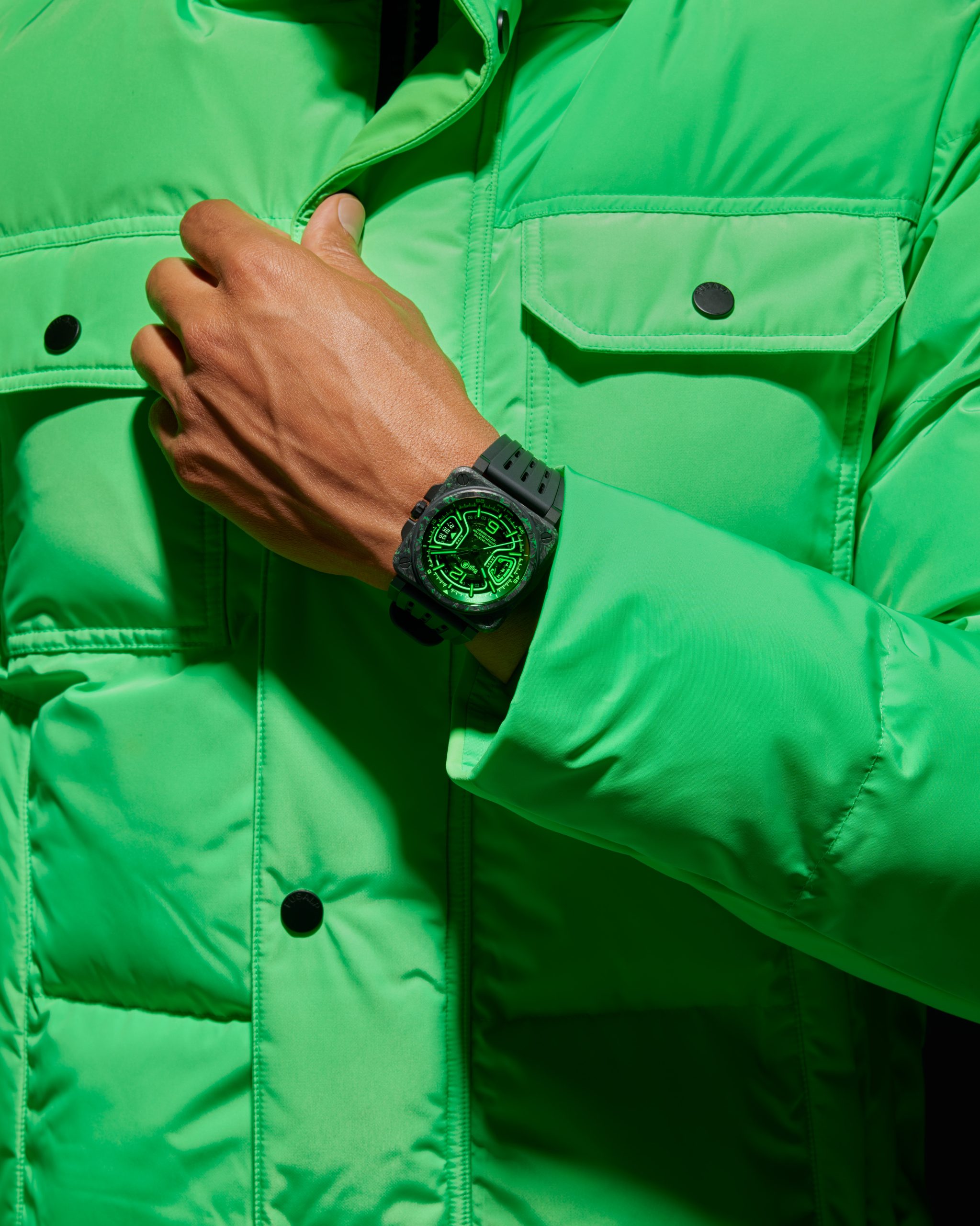
Bell & Ross Takes Flight With High-Performance Timepieces
The French-Swiss watchmaker expands its aviation-inspired universe with three bold new releases, each blending advanced materials, luminous design and mechanical precision.
By Jeni O'Dowd
Tue, Nov 4, 2025 9:38am 2min
Bell & Ross has re-engineered its iconic BR-03 line with the launch of the BR-X3 series, a new generation of professional instrument watches designed for those who live at the edge of performance.
The new models — the BR-X3 Black Titanium, BR-X3 Blue Steel and BR-X3 Night Vision — take the brand’s signature “circle within a square” aesthetic into more experimental territory, merging technical mastery with striking design.
At the heart of the BR-X3 line is the BR-CAL.323 calibre, a self-winding mechanical movement developed by Kenissi for Bell & Ross, offering a 70-hour power reserve and COSC-certified precision.
Each piece is built around a multi-component 41 mm case that uses advanced materials including titanium, steel, carbon fibre, and luminescent resin, with a 5-year warranty across the range.
Three Takes on Flight
The BR-X3 Black Titanium focuses on lightness and strength, combining micro-blasted titanium plates with a perforated rubber strap for comfort.
The BR-X3 Blue Steel channels the colour of the stratosphere, with polished and satin-finished steel, anodised blue aluminium pillars, and a sunray blue dial inspired by space flight.
Completing the trilogy, the BR-X3 Night Vision pushes into nocturnal territory, its LUM-CAMO carbon-fibre case infused with photoluminescent resin for readability in total darkness — a 250-piece limited edition referencing the green glow of aircraft head-up displays.
BR-X3 Black Titanium, left, and BR-X3 Blue Steel.
A Partnership Born in the Skies
Unveiled at the 2025 Paris Air Show, Bell & Ross became the official partner of the Rafale Solo Display, the French Air and Space Force’s official flight demonstration unit.
To mark the collaboration, the brand released the BR-03 Chrono Rafale Solo Display, a 500-piece limited edition that embodies the precision and performance of the fighter jet it honours.
Housed in a 42 mm micro-blasted black ceramic case, the chronograph features the BR-CAL.301 automatic movement with a 42-hour power reserve.
Its matte black dial incorporates aviation-inspired details — a yellow dotted line around the date window, orange chronograph hands, and the Rafale Solo Display insignia.
The watch comes on a black rubber or ultra-resilient fabric strap, both built for durability under extreme conditions.
The stunning BR-03 Chrono Rafale.
Precision Meets Passion
Since its founding in 1994 by Carlos-A. Rosillo and Bruno Belamich, Bell & Ross has built its identity around precision timekeeping for professionals — from fighter pilots to deep-sea divers.
The BR-X3 and BR-03 Chrono Rafale Solo Display extend that lineage, fusing experimental design with the technical sophistication expected of modern instrument watches.
For collectors and aviation enthusiasts alike, these new releases represent Bell & Ross at its most daring — and most authentic — where mechanical innovation meets the thrill of flight.
From Tokyo backstreets to quiet coastal towns and off-grid cabins, top executives reveal where they holiday and why stepping away makes the grind worthwhile.
From woven fibres to sculpted metal and clay, textural wall art is redefining high-end living spaces with depth, tactility and light.
By Sara Mulcahy
Tue, Dec 23, 2025 4min
In 2026, home interior trends are predicted to reflect our growing need for warmth, comfort and personal expression: a response, perhaps, to the fast-paced, always-on lifestyle many of us feel forced to embrace.
And where better to start than the four walls that define your living space? Unlike flat prints and traditional paintings, textured art invites engagement, creating a dynamic ambience in living rooms, bedrooms and outdoor entertaining spaces.
Interior designers are increasingly looking to create a multi-sensory experience, and wall art is a key part of that: blending art and sculpture, creating a focal point, and showcasing changing light patterns throughout the day.
Weaving ways
Sydney-based fibre artist Catriona Pollard uses traditional techniques to transform foraged plant fibres and recycled materials into evocative, sculptural works.
“I discovered weaving more than a decade ago, at a time when I was searching for a slower, more mindful way of creating,” she says.
“I had been working in a very fast-paced environment, and weaving became a way to reconnect with myself and with nature.”
Much of Pollard’s inspiration comes directly from the Australian landscape, from the textures of bark, seed pods and leaves, to the movement of wind and water.
“I see weaving not just as a technique, but as a dialogue with nature, where the materials guide the direction of the work as much as I do,” she explains.
Textural wall art is credited with bringing another dimension to how we experience art. A flat canvas is viewed front-on, but fibre works extend into space and interact with their surroundings.
They cast shadows that shift throughout the day, so the work is never static, it is alive and responsive to light.
“There is something visceral about woven materials,” says Pollard.
“People instinctively want to touch them, to feel the textures and patterns. Fibre carries its own history, whether it is a vine that once grew in the bush or copper wire that once carried electricity, and that embedded story becomes part of the artwork.”
Leaf Skeleton, Helen Neyland’s intricate metal wall art, captures the fragility of nature in sculptural form.
Metal magic
At the other end of the material spectrum, metal is also having a moment. Flexible, versatile and built to last, it brings a striking talking point to entertaining spaces indoors or out.
“I have been making sculptural wall art for over 30 years. I draw my ideas from organic shapes in nature and also from mechanical and architectural forms, and make work that has texture, depth and movement,” says Helen Neyland, artist and creative director at Entanglements Metal Art Studio at her Jasper Road studio in Melbourne’s Ormond.
“Metal wall art breaks away from a painting. It is 3D, it is textural, it works indoors or out, in foyers, large voids and bare walls. As the light passes through the day, the shadows change, stretching and falling across the wall. It gives you a work that is alive. You can backlight it for effect, or just let the light play naturally.”
Neyland notes that more people are seeking handmade, crafted pieces.
“There is more value placed on artisan work,” she says. “Sculptural wall art gives depth, presence and honesty that you do not get with mass-produced pieces.”
Stigmartyre by Brad Gunn evokes both reverence and unease.
Emerging artists
Bluethumb Gallery is Australia’s largest online gallery of original art, representing more than 30,000 emerging and established artists across the country.
Nadia Vitlin is one of them. Based in Sydney, she has a background in geospatial and biological sciences and describes her art as bringing together “the study of nature, humanity, emotions and sociological phenomena through the lens of the scientist”, via the tactile form of clay.
“I do also create two-dimensional works, and love having ‘flat’ art on my walls, but 3D and textured wall art is really having a moment,” she says.
“This may be because they are like hung sculptures more than they are paintings, and can contribute to the feel of a space rather than directly telling a visual story. Another thing may be that the tactility of a 3D object is quite irresistible.
“I always let gallery visitors touch my artworks – within reason! It is especially tempting because I make hard clay look soft, so the brain cannot help but want to feel it to understand it.”
Sculptor Brad Gunn agrees. “I think the element of depth captures the viewer’s eyes more quickly. It invites touch, and the tactile nature gives a secondary element to the work.
“Also, as the light changes in the room, either from the natural sun’s rays, overhead lighting or lamps, the work will cast its own shadows and feel different throughout the day.”
This story appeared in the summer issue of Kanebridge Quarterly Magazine. You can buy a copy here.


 2 min
2 min