Helicopter Parents Are Co-Piloting Their Adult Children’s Careers - Kanebridge News
Share Button

Helicopter Parents Are Co-Piloting Their Adult Children’s Careers

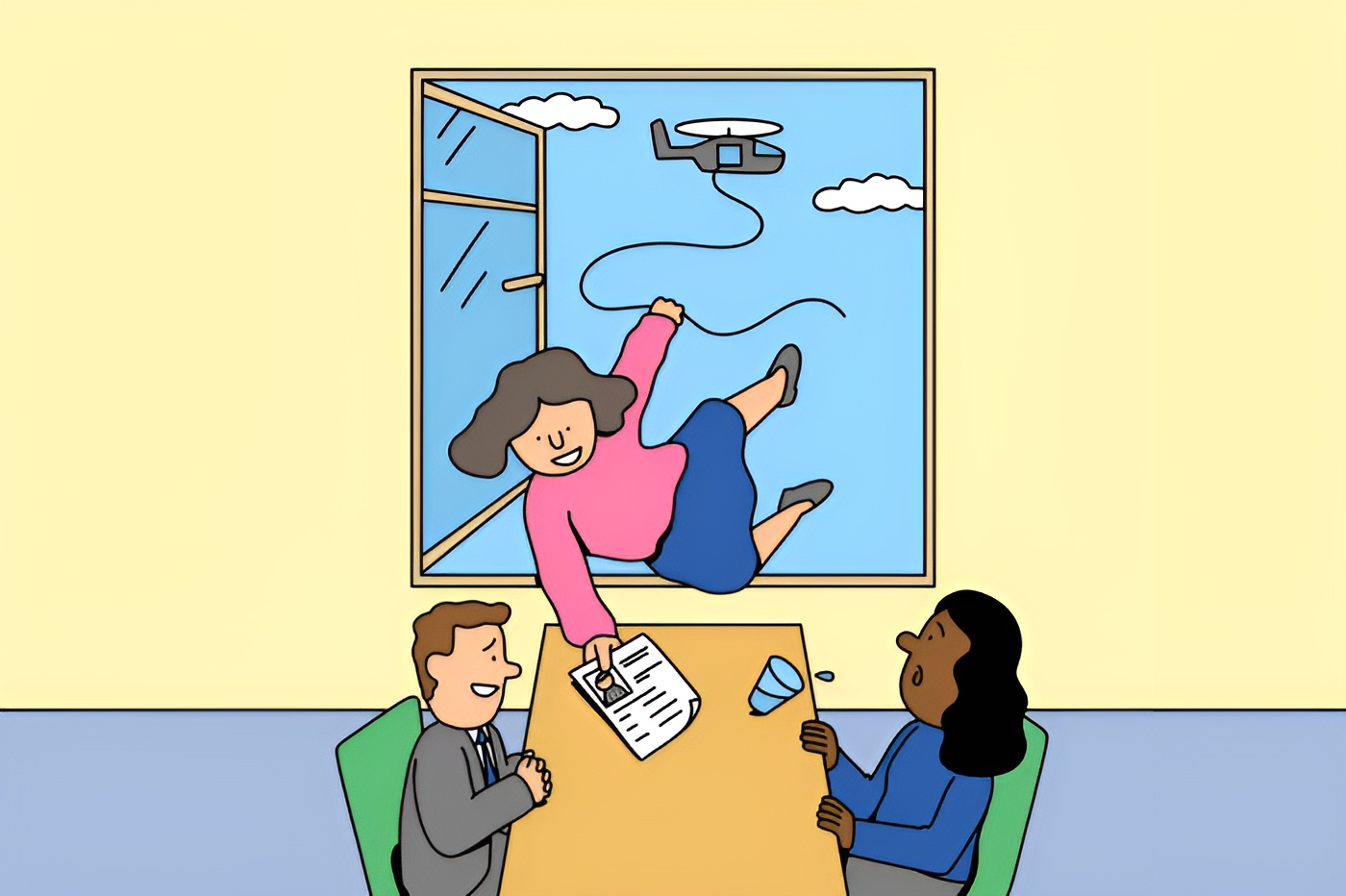
A growing number of employers say Gen Z job seekers are bringing their parents into the hiring process, from attending interviews and negotiating offers to questioning performance reviews. Recruiters warn the trend may raise concerns about independence, even as some families see it as support in a challenging job market.

By Ray A. Smith
Mon, Aug 3, 2026 5:36pmGrey Clock 4 min

Steven Clark had the unpleasant task of firing a 24-year-old—twice. Once was in a brief conversation with the new hire, who’d showed up late or not at all four times in his first week at a construction job.

Then Clark had to do it all over again, this time with the guy’s mother.

She called him a few hours later, pleading to give her son another chance. When Clark told her no, things got heated before he ended the call.

“I said, ‘Look, you know, this is between us and your son. He’s the employee,’” says Clark, who is chief operating officer of a Fairbanks, Alaska-based staffing firm.

Gen Zers make up nearly one-fifth of the adult workforce, and bosses and recruiters say it often feels like the nervous parents who hovered over them through childhood and college are right alongside them. What began as the occasional parent ride-along to a job interview coming out of the Covid era is now full-on career “co-piloting,” said Jasmine Escalera, head career coach at résumé templates service Zety.

More parents are calling up hiring managers, applying for jobs on their adult child’s behalf, and even showing up—or lurking just off-screen—on Zoom calls to help navigate difficult conversations or go over benefits packages.

“The first time it happened, I was appalled,” says Clark, who has fielded calls from parents asking why their child didn’t get a job. “Since then it’s become more of a here-we-go-again reaction.”

Human resource professionals have expressed outrage on social media.

“Parents should not be calling employers to check on their application status or ask questions on behalf of their child,” says Lynne Alba, a director of talent acquisition and physician recruitment at a large health system on Long Island, who vented about the phenomenon in a Tik Tok video she reposted on LinkedIn.

Lynne Alba
Lynne Alba Lynne Alba

At a recent job fair, a mother approached Alba with her daughter’s résumé, explaining that she wanted to work as a nurse. “While I appreciated that she was trying to help, I intentionally shifted my attention to her daughter. No matter what Mom said, I wanted to hear directly from the candidate,” says Alba.

Some parents who step in say it’s a challenging job market for young people, and that they would only intervene in extreme circumstances—social anxiety, a toxic boss, unfair treatment. There’s also a gray area of intervention that some see as an extension of the parental advice and networking help that’s been happening for generations.

Rick Wainschel last year published a post on LinkedIn asking his network to help his daughter, a recent college graduate, find a corporate entry-level position.

Wainschel, a vice president at an automotive marketing technology company, says he doesn’t think his outreach qualifies as helicoptering. “Well, maybe a little,” he said, before quickly adding he was being half tongue-in-cheek. “It was really merely just to help her get a network established. I just think the work world is a challenging place.”

Wainschel’s post, which was OK’d by his daughter on the condition he didn’t embarrass her, didn’t lead to a job but did result in productive conversations, he said. She found a job with a credit union on her own shortly after.

Recruiters and other HR types say aggressive parental involvement signals a lack of independence and raises fears that mom and dad will be checking in regularly if their kid gets hired.

What’s more, they say, such interference rarely, if ever, works.

The phenomenon is becoming so commonplace it made the agenda of human resources organization SHRM’s national conference in June. When James Harrell asked a room of 250 professionals if they ever had a parent calling on behalf of a young employee or coming to an interview, more than half raised their hands.

“The first time it happened to me, I got high up on my soapbox and I shook my fist,” Harrell says. “The 15th time I said, ‘OK, well, I gotta figure out how to do something differently.’”

Harrell helped run an apprenticeship program for high-school students while he was the human capital management chief for the San Antonio Independent School District. To run interference, the district introduced a “signing day” when parents could come and ask questions.

After a Gen Z employee at Nation’s Best Holdings, a chain of hardware and home goods stores, didn’t get an “exceeds expectations” designation on his performance review last year, HR chief Amber Little got a call asking why.

Amber Little
Amber Little Amber Little

It was one of a number of calls from parents her office has picked up recently about issues ranging from negative feedback to understanding which health insurance plan to choose. Little has even noticed parents are now calling in sick for their adult kids.

“Instead of coaching them, they do it for them,” Little says. When it happens, she adds, “we encourage them to tell their child to come talk to us and we will walk them through it.”

A Zety survey of more than 1,000 Gen Zers found 20% had a parent attend a job interview with them.

“You get a sense it’s all hands on deck for some families,” says Keith Wolf, managing partner of recruiting firm Murray Resources in Houston. His office has received emails from parents seeking jobs for their children, and Wolf says he’s always wondered if the kids even knew.

Paul “PB” Branson, who graduated from the University of Missouri-Columbia in May, bristles at the thought. The 22-year-old says while he understands their anxiety, parents shouldn’t be joining their children’s job interviews or contacting employees on their behalf.

“That trend,” he says, “has really hurt my generation by creating this kind of stereotype that we need our hands held.”

MOST POPULAR

The Australian leather house has opened an immersive four-day pop-up in Manhattan, unveiling its Bloom Collection and redefining what a product launch can look like.

Following the successful launch of its Palais Collection, MAISON de SABRÉ has unveiled a new modular handbag system offering more than 720 styling combinations.

Related Stories
Lifestyle
The Global Economy Looks Vulnerable to an AI Bust
By Jason Doughlas 12/11/2026
Lifestyle
The Parents Suing Schools Because Their Kids Got Bad Grades
By Zusha Elinson 10/11/2026
Lifestyle
How to Leave Your Career While Keeping the Door Open to a Comeback
By Callum Borchers 05/11/2026

The global economy is increasingly exposed to the risks of an AI slowdown, as data-centre investment fuels growth, trade and technology exports worldwide. While Asian economies benefit from booming chip and hardware demand, a pullback in AI spending could trigger market losses, weaken global trade and increase recession risks.

By Jason Doughlas
Thu, Nov 12, 2026 4 min

A message from the violent swings in stock markets over the past week: The fallout from an artificial-intelligence bust wouldn’t stop at the U.S.’s shores.

The AI build-out has been an engine of growth not just for the U.S. this year but for the whole global economy. Squeezed by the energy crunch caused by the Iran war, the world has relied heavily on U.S. data-center investment to power otherwise lackluster growth.

Global trade has thrived as Asian economies such as China, Taiwan and South Korea have enjoyed booming exports of computer chips, server racks and electronic equipment to feed ravenous demand for computing power in the U.S.

The Silicon Valley bounty is spreading as other economies join the party. Assembly hubs such as Vietnam and Mexico are seeing exports take off. Malaysia, Thailand and Australia are building data centers of their own. Europe’s industrial giants are supplying the power and cooling systems that make the AI revolution possible.

Yet the anxiety that spread through global markets in the aftermath of the U.S. midterm elections shows this growing dependency on Silicon Valley has a downside.

A slowdown in AI investment would punish exports in economies that in many cases show few other signs of growth. A sustained stock slide would crush mom-and-pop investors all over the world who have piled into technology stocks in anticipation of bumper returns. Overstretched budgets mean governments have limited room to respond with more spending.

Economists calculating what might happen if the pace of investment slows or the AI boom turns to full-blown bust say the only real question is how severe the global consequences will be.

“There is very little that can be done to prevent a global recession should the AI boom collapse,” said Frederic Neumann, chief Asia economist at HSBC in Hong Kong.

Stock markets have been on a wild ride since the Democrats’ victory in the U.S. midterm elections sparked concerns that Congress will hit the brakes on data-center development.

The latest upset in the industry has been the alleged spying scandal engulfing Nvidia, the linchpin of the AI ecosystem because of its deep pockets and advanced chips.

Stocks have clawed back some losses in recent days, moves that suggest many investors think the selloff is overdone. Even so, key stocks and indexes remain well below recent peaks. The tech-heavy Nasdaq index closed Wednesday 8% below its year-to-date high. Japan’s Nikkei index is down 16%, and South Korea’s Kospi, home to major memory-chip maker Samsung Electronics and SK Hynix, is down 43%.

For now, the stock-market gyrations haven’t spilled over into real economic activity, with global data pointing to the AI boom still going strong.

Jensen Huang, CEO of NVIDIA, gives a keynote address on stage in front of screens displaying partner company logos.
Jensen Huang is under scrutiny after an affair with an alleged spy. Sean Gallup/Getty Images

Asian economies are still seeing bumper export growth, with many of the gains driven by surging prices for chips and other hardware. China’s exports were up 35% year-over-year in October, according to figures from data provider CEIC. South Korea’s were up 93%, with Japan, Taiwan, Singapore and others also posting double-digit gains.

Economists at Capital Economics said the export bonanza means global trade is on track for its best spell of annual growth this year since the days of hyperglobalization in the early 1990s, excluding the big rebounds after Covid-19 and the 2008-09 financial crisis.

But the consulting firm warned that as much as 80% of recent export growth has been concentrated in AI-related goods, leaving global trade vulnerable to any change in U.S. spending on data centers. China, South Korea and other major economies are beset by weak consumption, meaning a drop-off in trade would have an outsize hit on growth.

Political and regulatory hurdles could drag on data-center investment. So, too, could rising interest rates or disappointments on earnings if AI firms’ revenues fail to keep up with outlays. The AI splurge already eclipses past infrastructure booms such as the railroads, and even without external pressure it might struggle to maintain that breakneck rate of growth.

As data-center investment slows, “AI capex will turn from a major prop to a drag on world trade,” Marcel Thieliant, head of Asia-Pacific at Capital Economics, said in a report.

Some economists have looked back to the dot-com bubble of the early 2000s as a yardstick to measure the possible costs to the global economy of an AI blowup.

In that episode, U.S. business investment sank and stocks crashed, hurting U.S. consumer spending and crushing imports.

Activists hold signs reading "Stop Data Centers" and "Off Fossil Fuels" during a protest.
Data centers were an issue in the U.S. midterm elections. Michael Nigro/Pacific Press/ZUMA Press

As a share of gross domestic product, U.S. imports of IT-related equipment fell 55% in two years from their mid-2000 peak, according to Oxford Economics—a drop that hit Asian and other economies that were suppliers of the goods. Global trade plummeted, and world growth in 2001 collapsed to just 2%, consistent with a global recession.

The globalized financing of the AI boom would in a bust spread financial pain around the world, adding to the damage from a steep fall in trade. Gaurav Ganguly, head of international economics at Moody’s Analytics in London, said the world would struggle to absorb a sharp AI stock slide on top of an oil shock, tariffs and rising interest rates.

“The result could be a severe economic shock with global recessionary consequences,” he said.