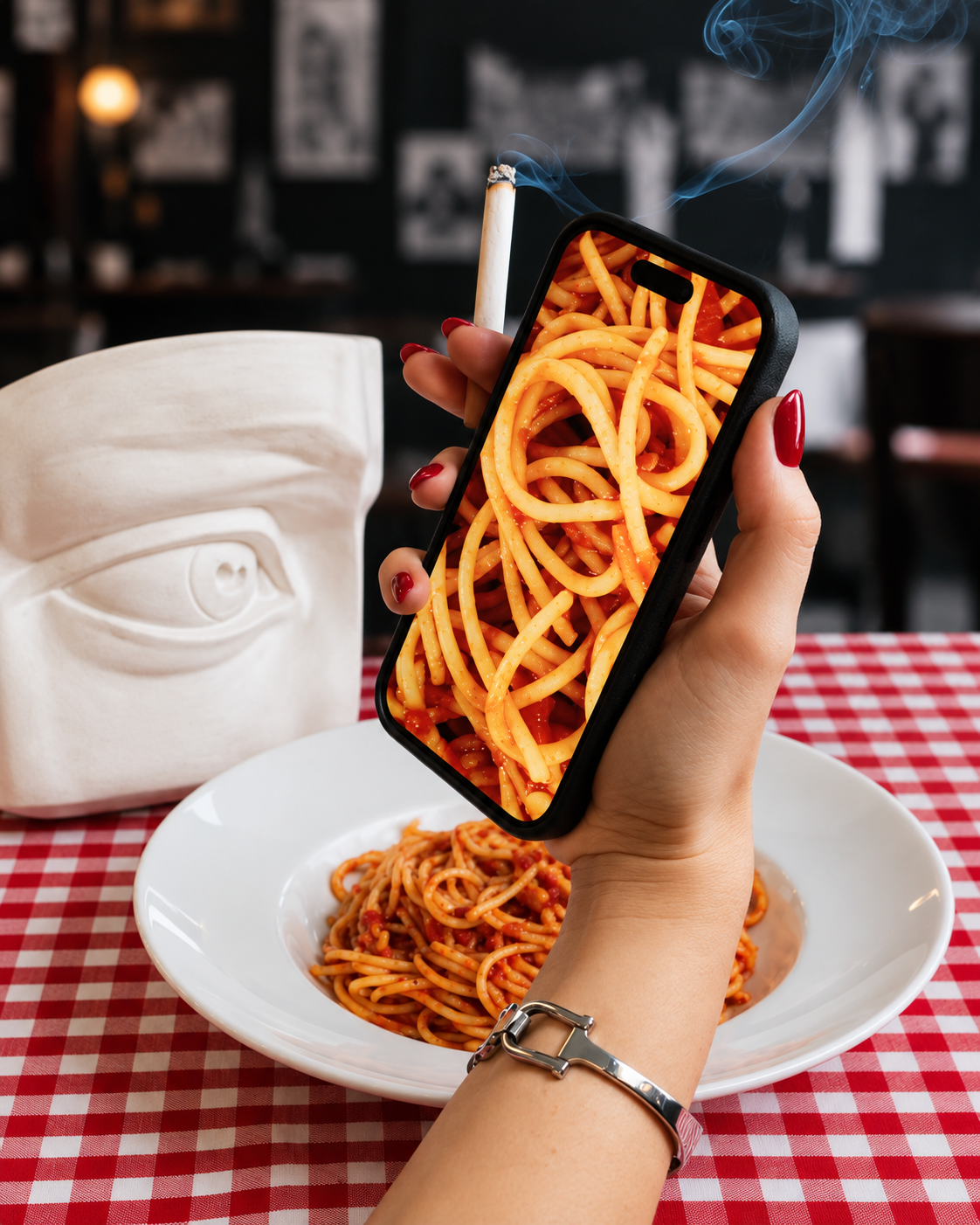
It wasn’t all that long ago that restaurants and bars around the country were dappled in the glow of cigarettes. Those days are over, but diners haven’t stopped lighting up—now it’s just with the blinding OLED gleam from their phones.
My seven-year run as a bartender started in the BlackBerry era and ended a few years after the birth of the iPhone. Back then, phone interruptions were mostly relegated to a few stray pings. If someone picked up a phone, it was usually only to say “Can I call you back?”
Today, phones are as common in a table-setting as napkins and silverware. If diners themselves aren’t pulling them out to check messages and social media, they’re likely in the background as others record Instagram videos or make FaceTime calls.
Many restaurants and patrons alike are pushing back against the shift that has turned collegial, communal spaces into places to watch TikTok while you eat. Here’s what some are doing—and what we can learn from them.
The phone lockup
Antagonist, a cocktail bar in Charlotte, N.C., is pretty antagonistic about phones. Upon entry, each customer receives a lockable Yondr pouch—the same bag some schools use to store students’ phones—that can only be opened by the staff.
“The main goal of our whole concept here really isn’t to burden anybody or take away their property,” Adam Horner, Antagonist’s general manager, said. “It’s essentially just to bring back a little slice of human connection that we all feel has been lost with technology.”
Even if your dinner destination doesn’t have the same rules, you can still borrow the basic idea. Keep your phone somewhere inconvenient or even mildly inaccessible: in your coat pocket, for instance, or your purse.
While Horner admits some patrons have arched an eyebrow at Antagonist’s policy, the benefit of having a place where people can be part of an organic social scene has far outweighed the potential loss of customers, he said. “I strongly encourage people to give it a chance, and sometimes they don’t and they go somewhere else.”
The airplane approach
The Edge, a local spot in Manhattan’s Harlem neighborhood, is a bit less rigid about phones. There’s no ban on them, but the restaurant doesn’t offer internet access. A sign at its bar reads: “No Wi-Fi. No Screens. Connect With Each Other.”
The directive is meant to encourage “stepping away from the digital and being present in the moment,” said Justine Masters, who owns The Edge with her sister Juliet.
Another way anyone with a smartphone can separate themselves from the internet: turn on Airplane mode. It may sound obvious, but it’s a simple and effective way to minimize phone-induced distractions while dining out.
The screen-free competition
For those wanting to break the grip of a bad habit, one tactic is to replace it with another better-for-you thrill. That’s the strategy behind the fast-food chain Chick-fil-A’s “cellphone coops.”
At a number of locations, diners can request a coop—a cardboard box—where they can put their phones while they eat. The goal is get groups to make it through an entire meal without checking their phones, with free ice cream as a reward. The coops even feature conversation prompts for the table.
You don’t need a cardboard coop to emulate the competition elsewhere—and if ice cream isn’t enough of a draw, treat the person who goes longest without using their phone to a free drink. Or make the loser pay the tip.
The point is to create rituals that result in discipline and, slowly, new habits.
What we gain from no-phone dining
The ubiquity of phones has not only eroded our manners, but also lessened the joys of bar and dining culture. One of Chris Hall’s favorite watering holes is The Saloon in Washington, D.C., a community-orientated beer bar with no televisions and a blanket ban on all phone use.
For him, it’s a bulwark against a bar culture that has become “very insular and not very fun.” He added that, over the years, he’s made at least a dozen friends at The Saloon. “You can talk to strangers in this place.”
Tina Vaughn and Chip Smith, the husband-and-wife owners of Eulalie, an upscale cloth-napkin bistro in Tribeca, also forbid phone use at their restaurant.
The policy is spelled out on a sign in the entryway and on the restaurant’s handwritten menus. Vaughn sees it as a way to help patrons combat the pressure to always be available.
“People want an excuse. They’re dying for someone to say, ‘You can get off that. It’s OK,’ ” she said. “The phone has become less a tool and more of a stress bomb, I feel, for so many.”



 4 min
4 min
 Copyright 2020, Dow Jones & Company, Inc. All Rights Reserved Worldwide.