Academia Is in Trouble and This English Professor Understands Why - Kanebridge News
Share Button

Academia Is in Trouble and This English Professor Understands Why

Randy Boyagoda’s new novel, “Lords of Serendipity,” delivers a biting satire of cheating, politics and dysfunction across modern universities.

By
Thu, Sep 3, 2026 5:49pmGrey Clock 5 min

Administrative cowardice. Rampant cheating. The soaking and scamming of undergrads and grad students. Performative wokeism. Intensifying competition for international tuition dollars from an expansive China.

These are either the latest dire headlines about American higher ed or the myriad subplots of “Lords of Serendipity,” an ambitious new novel by Randy Boyagoda. Unlike most campus fiction, its scope extends well beyond the cloister of the liberal arts classroom to whammy the entire university system, from its financial model to its function within a globalized economy. Along the way, it skewers its lightning-rod targets with a precision too sharp to be considered entirely fictional.

That its author is not only well-versed in satire, having written four other novels in the genre, but is also a professor of English at the University of Toronto and an experienced college administrator, further blurs the lines between comic fiction and brutal fact. It’s the kind of no-holds-barred book only a consummate insider would know to write—but only one who is also conveniently outside the American university system could get away with writing.

“This is someone who’s got the inside dope on what can go on at universities, especially with international students, and what kind of con games are going on,” said Margaret Atwood, a friend and fellow Torontonian.

The novel, like Boyagoda himself, is often very funny—even as the dilemmas its characters face read as tragedy. Its cast includes the bickering members of a Sri Lankan hotel cleaner’s family, insecure American freshmen, dead-end third-tier college professors and their highflying Ivy League counterparts and dispirited university functionaries. An old-fashioned Dickensian tale, it sweeps across continents and campuses, from a classic liberal-arts college to a stand-in for Harvard University to an urban technical school to the dilapidated buildings of a state-run university in Sri Lanka.

“I’m a joyful person,” Boyagoda said in an interview, though he prefers to see his outlook on academia as “hopeful” rather than optimistic. He smiles and laughs frequently. He bikes everywhere. He derives energy from his students and from his four daughters, ages 14 to 20. They help him and his American wife, Anna, also an educator, care for Boyagoda’s father, an immigrant from Sri Lanka who has dementia and lives with the family.

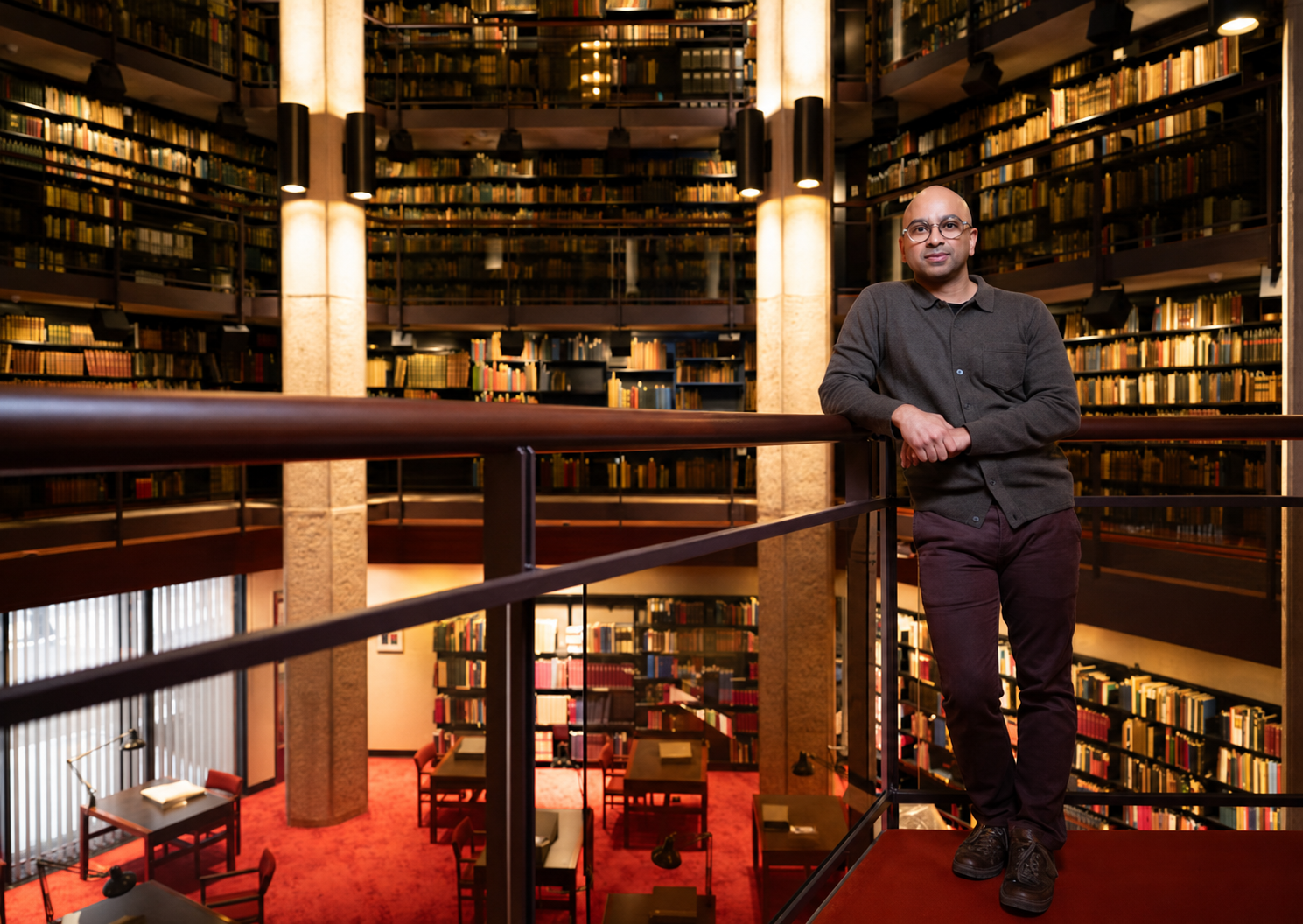
Randy Boyagoda speaks at a panel discussion.
Randy Boyagoda taking part in a panel discussion at the University of Toronto in 2024. Polina Teif/University of Toronto

The germ of the novel came to Boyagoda during the pandemic, when he was serving as a vice-dean. An urban legend was circulating about a statistics grad student selling passing grades to international students. The cheating scheme itself may well have been apocryphal, but it felt tantalizingly plausible.

“As a novelist, it stayed with me,” Boyagoda said. “Who would sell grades for a stats course? Why would someone buy grades? What’s motivating them? Why wouldn’t the university be doing something about it?” What he didn’t want to do, he explained, was write “another novel about a creative writing professor and his drama with students.”

In addition to writing novels—the first of which was a finalist for Canada’s prestigious Giller Prize; he’s written eight books in total—Boyagoda teaches literature full-time. For his students next semester, kids raised in a purportedly “post-literature era,” he’s assigning three 700-page novels, he noted mischievously, books by George Eliot, Ralph Ellison and Kiran Desai.

On RateMyProfessors, students remark on Boyagoda’s heavy assignments, tough grading and distaste for cellphones, but also hail his “comedy.” When alerted to these reviews, Boyagoda laughed. “Guilty as charged,” he said.

“Randy’s one of those people in academia who is very well educated but doesn’t have an ounce of superiority about him,” said John Irving, who frequently guest lectures in Boyagoda’s classroom. “It’s amazing to see how willing students are to talk in his classrooms, how little afraid they feel of being mocked or put down—he gets complete candor out of them.”

Negotiating competing interests seems to come naturally to him. Like many college campuses, after the Oct. 7 Hamas attack on Israel, the University of Toronto was embroiled in protests, encampments and discord; part of the school’s response was to convene a working group on civil discourse. Boyagoda was put in charge, serving for two years. It’s the kind of thankless task many professors would flee from, but Boyagoda relished the prospect and thinks the group, which is ongoing, made progress.

He has since pivoted to another formidable academic concern: the waning prestige of the humanities. In July, Boyagoda became the director of the Jackman Humanities Institute and special advisor on the humanities to the dean of arts and science. This fall, he is starting a series of gatherings he calls the Dead Book Club. (Dead writers feature heavily among his favorites: St. Augustine, Dante, William Faulkner, Evelyn Waugh, Saul Bellow.)

“The goal is to encourage students to read for its own sake and have conversation for its own sake,” Boyagoda said. “The importance of the humanities will be revealed to those who participate.”

Illustration of the book cover for "Lords of Serendipity" by Randy Boyagoda, depicting a woman wearing a hat with various buildings on top, against a blue background with a white airplane.

“Lords of Serendipity,” which publishes next week, reflects Boyagoda’s commitment to the pursuit of knowledge: “I’m supposed to say I learn more from my students than they do from me, but no,” Boyagoda said. “I enjoy sharing my excitement and joy about literature and ideas. There are these moments when you are teaching and you can see someone’s face change because they didn’t know something and then they did. That moment when you’re actually watch someone enlarge themselves is deeply satisfying.”

In literary circles, Boyagoda is often referred to as a Catholic novelist, a description he embraces. “A novelist willing to give shape and voice to contemporary religious experience is needed,” Boyagoda said. “I understand myself as a Catholic novelist, provided that I’m not only a Catholic novelist, I’m also a South Asian novelist and I’m a Canadian novelist. I don’t want to be captive to one label.”

His characters, he said, are subjected to what he calls “Graham Greene character situations.”

“They are trying to do good in a fallen world and realize the most they can do is less harm than someone else would do in that same role,” he explained. “They have to accept they are complicit in something that provides some good thing to others. It’s a very Graham Greene way of thinking about sacrifice.”

The campus green they inhabit is a febrile zone in which lofty ideals and cynicism regularly collide. It’s a place where a traditional holiday college celebration is now an occasion for political protest. Kids freely police one another inside and out of the classroom with social media their constant, ready weapon of choice. International students, knowing their family’s financial futures hinge on their degrees, operate in terror of failure and deportation.

Early readers of the book include Gary Shteyngart and Junot Diaz, both of whom have taught at universities and written comic novels. They each contacted Boyagoda midway through to say, in essence, “You nailed it.”

As biting as “Lords of Serendipity” can be, Boyagoda’s faith in higher education remains undaunted.

“It’s absurd that we live in societies that make the decision to take people between the ages of 18 and 22, when they are most physically capable of contributing to our nations and communities, and tell them, ‘Go away for four years, and read and learn and have conversations,’” he said. “I want students to be aware of what an incredible privilege that is.”

Corrections & Amplifications
Randy Boyagoda is a special advisor on the humanities to the dean of arts and science at the University of Toronto. An earlier version of this article incorrectly said he is a special adviser to the dean of humanities. (Corrected on Sept. 2)

MOST POPULAR

The Australian leather house has opened an immersive four-day pop-up in Manhattan, unveiling its Bloom Collection and redefining what a product launch can look like.

Following the successful launch of its Palais Collection, MAISON de SABRÉ has unveiled a new modular handbag system offering more than 720 styling combinations.

Related Stories
Lifestyle
How Lego Is Getting More Adults to Tinker With Their Toy Bricks
By Saabira Chaudhuri 19/10/2026
Lifestyle
Apple Joins Nvidia in the $5 Trillion Valuation Club
By Rolfe Winkler 15/10/2026
Lifestyle
AI Agents Are a Threat to Travel Businesses. Airbnb Could Still Be a Winner.
By David Wainer 13/10/2026

LEGO is expanding beyond its traditional audience by tapping into people’s passions, from flowers and gaming to music and Formula One, through creative products, immersive experiences and social-first marketing. The strategy is paying off, with revenue rising 21% in the first half of the year to a record DKK 41.9 billion.

By Saabira Chaudhuri
Mon, Oct 19, 2026 5 min

Lego’s core audience was once young boys. But in recent years the world’s largest toy maker has expanded its reach, attracting more adults, teenagers and girls.

At the center of this expansion has been a strategy to tap in to people’s interests and hobbies—the Danish toy-brick maker calls them “passions”—many of which cross demographic boundaries. These include personal preoccupations like bonsai trees and golden retrievers, celebrities such as pop star Olivia Rodrigo and mega events like Formula One and the World Cup.

That has led to new types of building sets, including more sophisticated models that adults can display on their coffee tables, and a shift in marketing strategy, with Lego pouring money into experiences and social-media skits aimed at fans.

For Formula One watchers, Lego built life-size, drivable replicas of the teams’ race cars, which drivers took around the circuit at last year’s Miami Grand Prix. To reach gaming fans, Lego in August showed up at the Gamescom trade event in Cologne, Germany, with a giant Minecraft Lego chicken that visitors could sit on.

“We go not just for the people who are there, but because the types of things that we create become big social-media engagement,” says Julia Goldin, Lego’s chief product and marketing officer.

The strategy has helped spur growth. In the first half of this year, privately held Lego’s revenue rose 21% from the year-earlier period to a record 41.9 billion Danish kroner ($6.27 billion), while net profit climbed 32% to 8.6 billion kroner.

The Wall Street Journal spoke to Goldin about how the company researches people’s passions and turns these into products and marketing campaigns.

Edited excerpts follow:

Beyond demographics

WSJ: Adults have become a big focus for Lego—what’s behind that?

JULIA GOLDIN: Over the past eight years, we said there was a bigger opportunity with adults—not just people who are super-high-affinity fans, but people who maybe built a long time ago or had never built with bricks before—by giving them the things they would love to build now.

We approached adults from a passion-point perspective from the very beginning. We said we need to understand what they’re into. So, we looked at men, we looked at women, we looked at what their big interests were, what types of things they like to collect, what types of things they wanted to display in their rooms, etc. Now you can put Gustav Klimt’s “The Kiss” on your wall, or if you’re into animals, some cute floating sea otters. And then gamers who love a bit of ’80s or ’90s nostalgia can build and display the Game Boy.

We are now seeing strong growth with both adults and kids.

WSJ: How do you find out about people’s interests?

GOLDIN: We do a lot of trend-seeking and social listening. We look at viewership of various programs, behaviors, what’s trending socially. Then we dive quite deeply into these interests through primary research, ethnographic research and interviews.

AI has helped us ramp this up. There are tools where you can ask, with the right prompts: “People who are passionate about F1, what are they talking about? What are the latest conversations on Reddit?”

WSJ: Lego flower bouquets and trees are among the company’s most popular sets. How and when did that come about?

GOLDIN: When we started to talk seriously about adults, we could see that some people were into gardening and flowers. We launched the first flower bouquet in 2021 and completely underestimated how successful it would be. We started with the 18-plus age group because we thought that’s where the sweet spot is. But we realized that younger girls, especially teens, really love to build Lego flowers so we expanded the range.

You might think botanicals are women and F1 cars are men. But that’s why we talk about interests and not just gender and demographics. Yes, botanicals have a huge following among women and teenage girls, but bonsai trees are one of the top 10 products for men and teen boys. Speed Champions F1 cars show up in the top 10 for teen girls. I thought most of Olivia Rodrigo’s following would be girls, but my 16-year-old son asked me for two sets because his friends are massively into her.

That’s why we don’t market to a demographic. You can never be assumptive about how that breaks down in terms of gender.

WSJ: How has this shift in thinking changed your products and marketing?

GOLDIN: F1 is a great example. In the past, we might have started with a partnership with a team and a great Lego car for people to build. But we understand that it’s a multigenerational passion and different people are in it for different things. Some people love the cars, some collect, some follow the actual sport of racing, and some have tremendous passion for the drivers and their teams. That is why our F1 portfolio spans everything from Duplo [bricks] for toddlers to detailed display models and driver helmets for older fans.

Two drivers in a full-scale Formula One car built from black and green Lego bricks during a driver parade.
A full-scale Formula One car made from Lego bricks in Miami. Alessio De Marco/Ipa Sport/ZUMA Press

But then we ask ourselves: What can we do to go beyond the products, to give fans Lego brand experiences that they would never expect? That’s why in Miami last year we built 10 full-size Lego Formula One cars, with nearly 400,000 bricks in each, and put all 20 drivers in them for the driver’s parade. Everyone assumed they were static models, until the drivers started lapping the circuit and we saw a tremendous amount of excitement and social media buzz. We generated something like two, three billion views.

WSJ: Do social-media views of a marketing event translate into significant sales of Lego sets tied to these campaigns?

GOLDIN: Yeah, of course. We don’t share data, but I can tell you they’re some of our most successful products.

‘She Built That’

WSJ: You say Lego is growing particularly strongly with girls. What is driving that?

GOLDIN: We used to have only Lego Friends as the one big line for girls, and some Disney products like “Frozen.” But rather than looking at toy categories that were selling to girls, like dolls, and trying to replicate that, we really worked to understand what girls are into.

We realized girls are super into pets and creatures, nature and flowers, socializing and music. We expanded significantly around those areas with botanicals, animals, K-pop and Olivia Rodrigo.

A fan views Lego artwork and displays at the Lego Editions Olivia Rodrigo Collection pop-up.
Fans at the Lego Editions Olivia Rodrigo Collection pop-up in London. David Parry Media Assignments/PA Wire/ZUMA Press

We also did the “She Built That” campaign, very strongly saying girls can build just as well as boys. I’ve heard for a long time that “girls don’t like to build because moms don’t,” but that’s just not true. We’re showing them things they really love to build, and that’s why it works.

WSJ: Why do you think adults, teens and others are turning to Lego more nowadays?

GOLDIN: There’s an overriding sense of lack of purposefulness and this drowning in content that you’re constantly being fed. Three hours have gone by and you’ve just been scrolling through feeds of reels. People are getting really tired. They want to actively do something that’s more purposeful and lasting.

When they build with Lego sets, they say they feel creative. They want to do something they can be proud of—where they can say, “Wow, I did this.”