An 18th-Century Barbados Villa Built Over a Network of Ancient Caves Lists for $22.5 Million - Kanebridge News
Share Button

An 18th-Century Barbados Villa Built Over a Network of Ancient Caves Lists for $22.5 Million

Kit Braden, an executive at French beauty empire L’Occitane, has spent every winter for the past 13 years at the stone vacation home.

By CHAVA GOURARIE
Mon, May 11, 2026 10:57amGrey Clock 2 min

A historic Barbados estate with a 300-year-old villa and 11 acres overlooking the Caribbean Sea is now for sale with a guide price of $22.5 million.

The seller is Kit Braden, chairman of the U.K. branch of French beauty empire L’Occitane Group, whose family has spent every winter for the last 13 years at the island property, known as Fustic Estate.

“It’s very much a family house,” Braden said. “We love having a lot of people there. It’s a collection point to keep everyone together.”

The main villa dates to 1712, though it’s been reimagined and expanded substantially over the years.

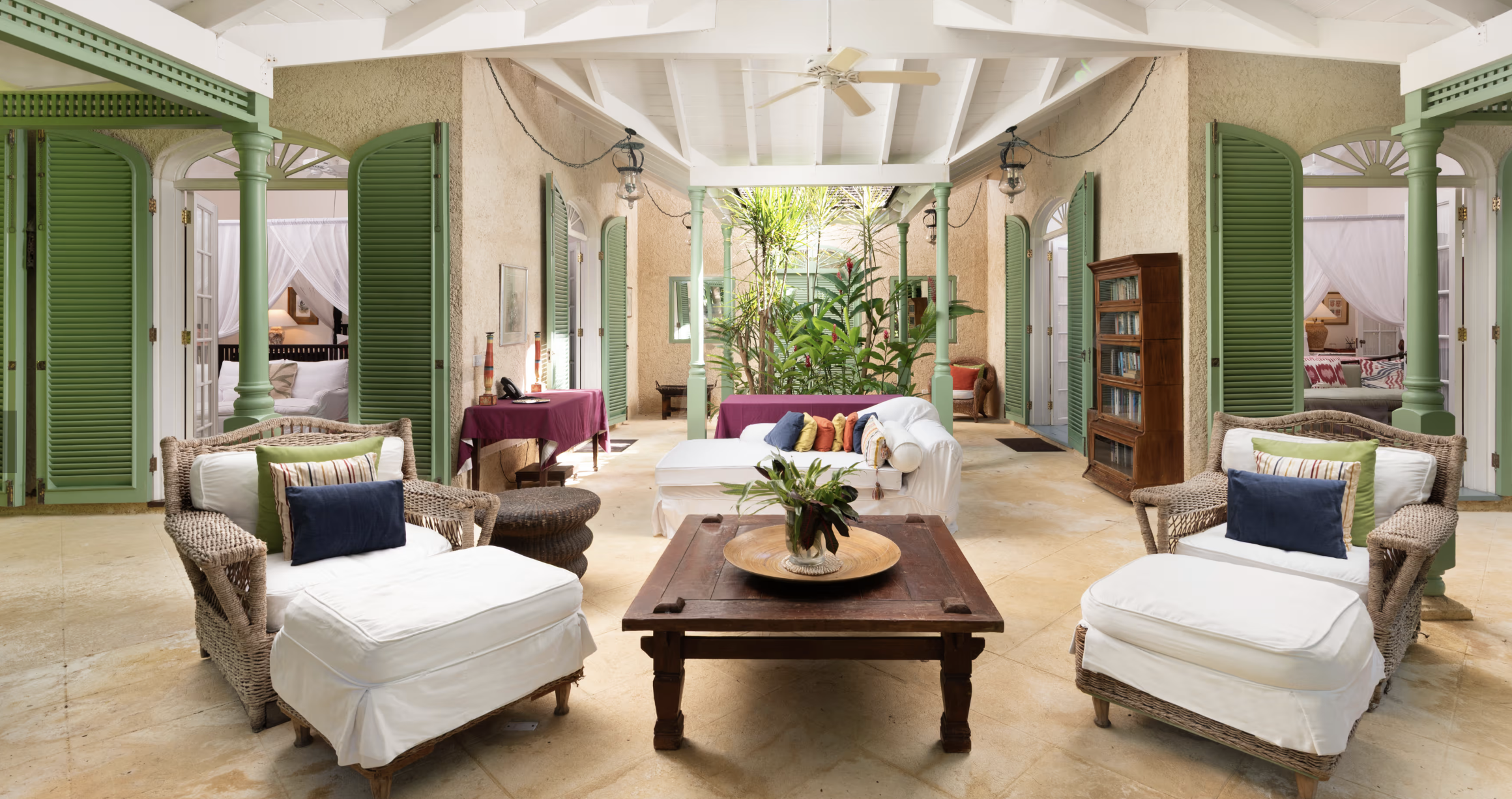
It spans 13,000 square feet and features seven en suite bedrooms across three wings, as well as expansive verandas, stone courtyards and rows of louvered doors in gay Caribbean pastels.

In the 1970s, when the home was owned by Charles Graves—brother of British poet Robert Graves—it was reimagined by stage designer Oliver Messel, one of the foremost theater designers of the last century. Messel expanded the home, added a lagoon pool with a natural waterfall and other theatrical features, according to Braden.

“The whole place is a little bit magical,” he said.

The home sits about 350 feet above the water, and surrounded by lush gardens that slope towards the water.

“We look down through our garden—which is about 12 acres of tropical gardens and palm trees and wonderful old mahogany trees—onto the Caribbean,” Braden said.

He and his wife first saw the property on New Year’s Eve 2013, during a quick trip from where they were staying in Grenada.

The couple spent an hour walking the perimeter, some of it still untouched jungle, in the pouring rain.

“By the time we got back, I had fallen in love with it,” Braden said.

His wife, however, wasn’t so sure. But in Braden’s telling, a second visit in sunnier weather with two of their children brought her around.

“She had to be talked into that it was a jolly good idea; now she absolutely loves it,” he said.

When they bought the property, the edge that runs along the waterfront was a jungle, so they cleared the ridge and transformed it into gardens.

They also bought an additional sea-level parcel with two beach cottages, giving the property direct access to the water and the town below via a five-minute walk.

The property also has a 15-person staff, a reflecting pond, an outdoor pavilion suitable for yoga and a commercial grade kitchen that can serve more than 100 guests, according to a brochure from Knight Frank, which posted the listing in March. They did not provide further comment.

For Braden, the property is special because of its natural beauty, its proximity to the town of Saint Lucy and its history—which dates way way back to when the island of Barbados was first formed via tectonic activity.

“It was basically tectonic plates that collided about a million years ago so the seabed is the top of the hill,” Braden said. “We’re on coral rock.”

As a result, Fustic Estate includes an extensive network of caves that were likely used by the Arawaks, a Venezuelan fishing tribe that followed the fish to these islands about a thousand years ago.

“If the fish were good they’d camp here,” Braden said. “There’s evidence that they stayed there in those caves, they lived there in good winters.”

Now it’s someone else’s turn to live on the land shared by Arawaks, the plantation owners of 1712, Charles Graves and the Braden brood.

MOST POPULAR

Automobili Lamborghini and Babolat have expanded their collaboration with five new colourways for the ultra-exclusive BL.001 racket, limited to just 50 pieces worldwide.

Rugged coastal drives and fireside drams define a slow, indulgent journey through Scotland’s far north.

Related Stories
Property
Wealth on the rise as billionaires reshape Australia’s property landscape
By Staff Writer 23/04/2026
Property
Late Swarovski Billionaire’s Private Island Near Venice, Italy, Asks €24 Million
By Casey Farmer 23/04/2026
Property
INSIDE ONE OF THE WORLD’S MOST EXCLUSIVE POSTCODES
By Jim Motavalli 07/04/2026

Australia’s wealthy class is expanding fast, and Knight Frank says that a surge in billionaires is reshaping the nation’s luxury property market.

By Staff Writer
Thu, Apr 23, 2026 3 min

Australia’s luxury property market is being quietly reshaped by one of the most significant wealth expansions in the world. 

According to Knight Frank’s latest Wealth Report, the country’s billionaire population is set to grow by 77 per cent over the next five years, rising from 48 to 85 individuals. 

That surge sits within a broader wave of wealth creation. Ultra-high-net-worth individuals, those with more than US$30 million, are forecast to increase by nearly 60 per cent to over 26,000 Australians by 2031. 

Globally, the pace is accelerating. The report reveals that 89 new ultra-wealthy individuals are created every day, a figure that underscores a structural shift in capital formation rather than a cyclical upswing. 

For luxury property markets, this is not just a headline number. It is a demand driver. 

Australia’s wealth story is increasingly underpinned by diversification across resources, finance, technology and services, creating a depth of private capital that is both mobile and strategic. 

And mobility is key. The ultra-wealthy are no longer tied to a single market. Instead, they are operating across multiple global hubs, maintaining footholds in cities like London, New York and Singapore, while using Australia as a stable base. 

In this environment, real estate becomes less about shelter and more about positioning. Trophy assets remain desirable, but capital is increasingly being deployed across the full risk spectrum, from long-term holds to value-add opportunities. For Australia, the implications are clear. As wealth expands, so too does the expectation of product, and the locations that can attract it. 

The billionaire effect  

While property remains central to wealth preservation, the latest data shows that capital is increasingly spreading across luxury asset classes, albeit with a more disciplined approach. 

Knight Frank’s Luxury Investment Index recorded a modest 0.4 per cent decline in 2025, signalling a stabilisation phase after several years of correction. 

But beneath that headline number is a more telling shift. Collectors are moving away from speculative buying and toward assets defined by rarity, provenance and cultural significance. 

Impressionist art led the market, rising 13.6 per cent, buoyed by landmark sales including a US$236 million Klimt painting. Watches also performed strongly, up 5.1 per cent, driven by continued demand for brands like Patek Philippe and Rolex. 

At the same time, more volatile categories have corrected. Whisky values fell 10.9 per cent, while parts of the fine wine market have softened following pandemic-era highs. 

Perhaps the most notable trend is behavioural. Younger investors are entering the market through fractional ownership platforms, gaining exposure to high-value assets that were once out of reach. 

For property, the parallels are clear. The same focus on scarcity, narrative and long-term value is increasingly shaping buying decisions at the top end of the residential market. 

Global wealth  

The growth in billionaires is not just increasing demand, it is changing where that demand is directed. 

In Australia, Brisbane has emerged as one of a handful of global cities experiencing rapid change in its luxury positioning. The city’s transformation is being driven by infrastructure investment and the 2032 Olympics, with top-end apartment prices rising from around US$6 million to more than US$10 million in just 12 months. 

Luxury price growth has remained steady, with Brisbane rising 2.1 per cent in 2025, while the Gold Coast recorded 2.8 per cent. 

At the same time, buying power is tightening. US$1 million now buys 5 per cent less in Brisbane than it did five years ago, reflecting the upward pressure on prime markets. 

The trend is not confined to capital cities. Regional lifestyle markets are also capturing attention. Geelong’s waterfront has been identified as one of the world’s hottest luxury residential markets, driven by a combination of coastal amenity, infrastructure and relative value. 

In these markets, pricing is no longer the sole driver. Lifestyle, accessibility and long-term growth are increasingly shaping buyer decisions, particularly among globally mobile wealth. 

Alternative luxury assets  

Beyond residential property, high-net-worth individuals are continuing to diversify into alternative assets that combine lifestyle and investment potential. 

One of the most compelling examples is vineyard investment. Knight Frank’s Global Vineyard Index highlights the Barossa Valley as one of the best-value wine regions globally, where US$1 million can secure more than 18 hectares of land. 

Despite a 10 per cent decline in land values over the past year, the broader outlook remains positive, particularly as the global wine industry shifts toward premiumisation. 

This “trading up” trend is seeing consumers favour higher-quality, provenance-driven wines over mass-market products, reinforcing the long-term appeal of established regions like the Barossa and Eden Valleys. 

For investors, the appeal lies in the intersection of lifestyle and capital preservation. Vineyard assets offer not only production potential, but also a narrative — something increasingly valued in a market where experience and authenticity carry weight.